
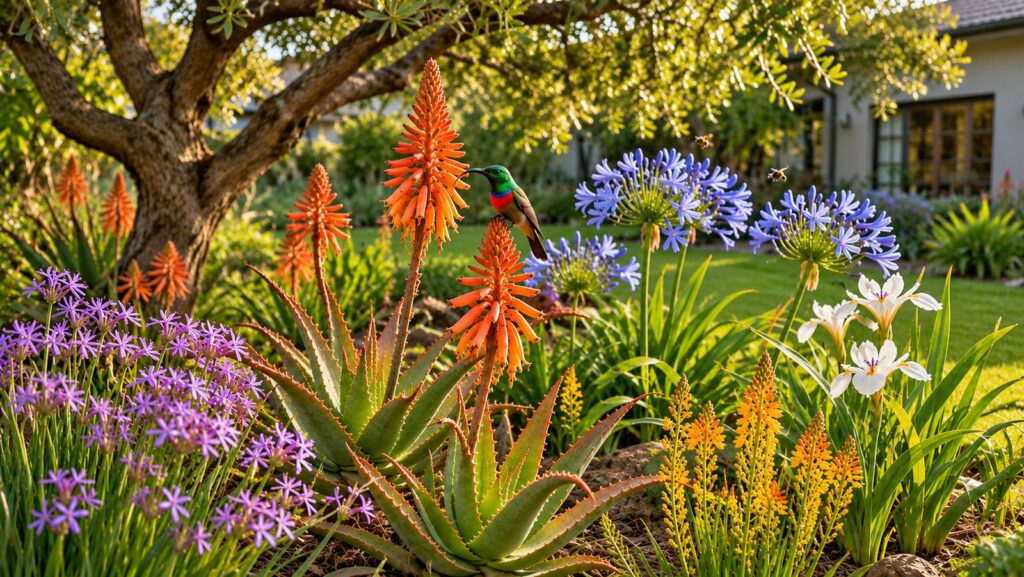
Indigenous Gardening in South Africa: Waterwise Plants and Healthier Soil
South Africa is a dry country, with an average annual rainfall of about 464mm (gov.za). When every drop counts, indigenous gardening is the easiest way to a beautiful, low-water garden, because the plants already belong here.
Indigenous plants have adapted to our rainfall, heat and soils over thousands of years. Pair them with healthy soil fed by bokashi, and you have a garden that thrives with far less watering.
Why choose indigenous plants?
- They need less water. Once established, many survive on rainfall alone.
- They’re low maintenance. Plants suited to local conditions need less feeding, spraying and fussing.
- They cope better with local pests and diseases, because they have grown alongside them.
- They bring wildlife into your garden. Local birds, bees and butterflies are adapted to local flowers.
- They protect something special. The Cape Floral Kingdom is the smallest of the world’s six floral kingdoms and the only one found within a single country, with more than 9,000 plant species (City of Cape Town). Growing indigenous plants helps keep that heritage alive.
Easy indigenous plants to start with
These are widely grown across South Africa and forgiving for beginners.
Plant | Best spot | Why grow it |
|---|---|---|
Wild garlic (Tulbaghia violacea) | Full sun | Tough border plant with purple flowers for months |
Agapanthus | Sun to light shade | Hardy, with blue or white summer flowers |
Wild iris (Dietes grandiflora) | Sun or light shade | Almost indestructible, flowers on and off all year |
Aloes, such as krantz aloe (Aloe arborescens) | Full sun, dry areas | Winter flowers that bring sunbirds |
Bulbine (Bulbine frutescens) | Full sun | Very drought tolerant groundcover with yellow or orange flowers |
Gazania | Full sun | Bright, low groundcover for hot, dry spots |
Spurflowers (Plectranthus) | Shade, such as under trees | Purple or white autumn flowers where little else grows |
Spekboom (Portulacaria afra) | Full sun | Fast, waterwise succulent for hedges and pots |
What thrives depends on where you live. On the Highveld, frost can damage tender plants such as spurflowers and spekboom, so ask your local nursery which indigenous plants suit your area.
Indigenous trees and rainwater
A tree does more than give shade. Its leaves slow heavy summer rain, and its roots and fallen leaves help water soak into the soil instead of running off into the street. That means more water for your garden and less stormwater rushing into drains.
Hardy indigenous trees for a home garden include:
- Wild olive (Olea europaea subsp. africana): evergreen, tough and drought tolerant.
- Karee (Searsia lancea): a fast-growing shade tree that copes with frost and drought.
- White stinkwood (Celtis africana): a graceful tree with fresh spring leaves, good for bigger gardens.
Plant trees well away from walls, paving and pipes, and leave fallen leaves under them as a natural mulch.
How bokashi helps: soil that holds water
Even waterwise plants grow better in healthy soil. Soil rich in organic matter holds water like a sponge, so rain and watering stay where your plants’ roots can reach them. Bokashi is an easy way to add that organic matter from your own kitchen.
- Dig bokashi pre-compost into your beds before planting. Our guide, 5 Ways to Use Bokashi in Your Garden, shows you how.
- Mulch the soil surface with leaves or bark to cut evaporation.
- Water deeply but less often, so roots grow down instead of staying near the surface.
- Feed with diluted bokashi tea from your bucket’s tap. See Spring Garden Boost for the mix.
What goes into your bokashi bucket today feeds your garden next month, instead of the dump.
Grow a garden that belongs here
Indigenous plants, healthy soil and less water: start with your kitchen scraps. Not sure which bokashi kit suits your household? Our kit buying guide helps you choose in a minute.
Questions? Email info@bokashibran.co.za or call 082 456 9225.
Sources
- South African Government: Geography and climate (average rainfall about 464mm)
- City of Cape Town: Our floral kingdom (smallest of six floral kingdoms, more than 9,000 species)